Nature & Animals
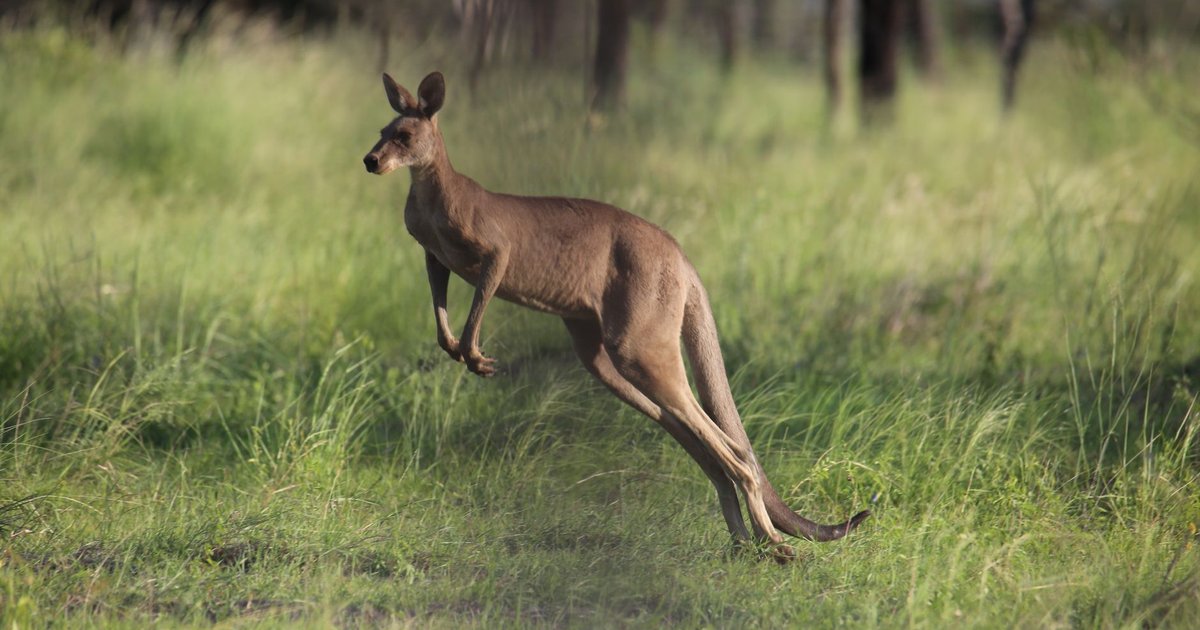
How a Kangaroo Bounces Like No Other Mammal
A kangaroo's tail doesn't just hang there. It's a fifth leg—a muscular brace that anchors the entire bouncing system and does nearly as much work as any of the four actual limbs.
Watch footage of a kangaroo at speed and you're seeing something genuinely odd: the animal rocks forward on its tail and hind feet together, then launches. At full sprint—around 35 miles per hour for a large red kangaroo—the tail and legs work in perfect sync, flinging the body forward in bounds that cover 25 feet. That's the same distance a professional basketball player travels with a running start, crossed in a single leap.
The real trick is energy. Most mammals burn fuel with every stride. A kangaroo burns less. The tendons in the hind legs store elastic energy on landing, then release it on the next bounce like a pogo stick. The tail acts as both a third point of contact and a counterbalance—without it, the hopping gait would collapse into something less efficient. A kangaroo with an injured tail can still move, but it's visibly labored.
This isn't just speed, it's economy. Over long distances, a hopping kangaroo uses less energy per mile than a galloping horse or dog. The faster a kangaroo goes, the less fuel it actually burns per unit of distance. Up it to 40 miles per hour and the animal becomes more efficient still. No other large terrestrial mammal has cracked this particular code.
The system works almost nowhere else. A few rodents hop. So do hyraxes, and some primates. But none of them scale it to a 200-pound animal covering open savanna. The kangaroo's tail-and-spring design remains the only version that works at that size and that speed—which is less a coincidence of evolution than a boundary condition of biomechanics itself.
More from Nature & Animals